Half of the Sky, the Whole Sky

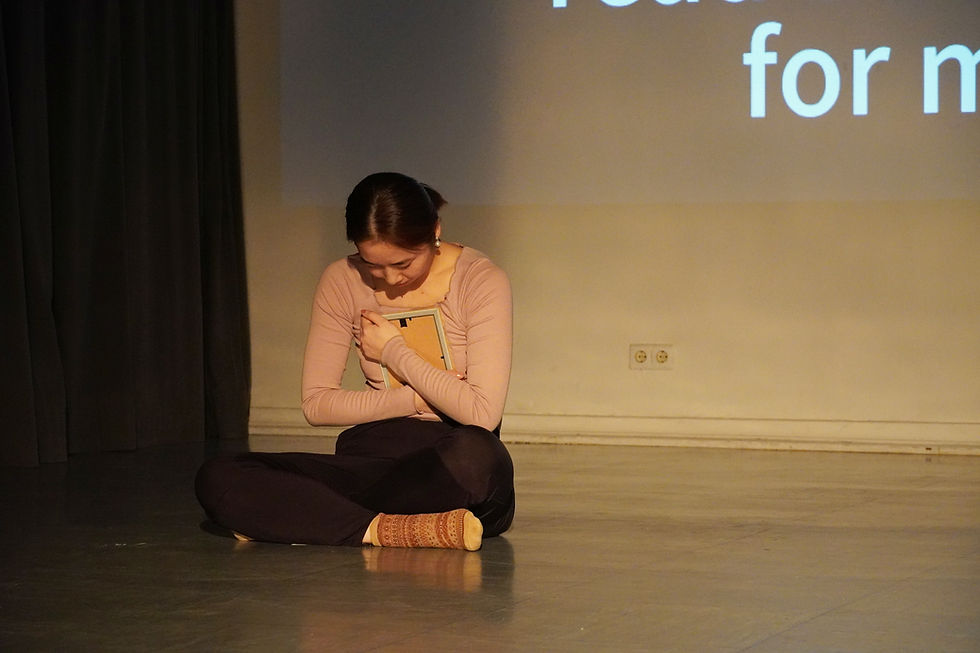
The dance performance Half of the Sky, the Whole Sky, a dance performance that brings together interviews, archival photographs, and body gestures to explore one central question:
Why should women never give up writing?
Team
Concept / Production / Performer: Yinfu Gao
Tanzdramaturgie: Patscharaporn Distakul
Music: Chloe Liuyan Liu
Light: Simon Lenzen
Poster Design: Yi Li
Research Support: Xiaoya Fang, Wenxuan Lu, Alex Wilke, Selina Kötter, Chengcheng Hu
Special thanks to my grandmother Jiebing Jiang.
Supported by:
Thanks for the support of Kulturamt Frankfurt, HMWK, Offenes Haus der Kulturen, Sinologie Department of Goethe University
Through the story of my family and the life of the revolutionary writer Ding Ling (丁玲 1904–1986), this work reflects on the legacy of women who wrote—despite political oppression, historical turbulence, and silence imposed upon them. Inspired by Ding Ling’s life experience, I look at how writing has shaped generations of women in my own family and how their stories continue to resonate today.
In the choreographic research, we studied the artistic policies and performance practices of 1937–1942, the turning point in Ding Ling’s literary trajectory. We discovered that Western ballroom dances—introduced by journalists from the Frankfurter Zeitung—and local Yangko folk dances once existed side by side in the same historical locations. At the same time, Ding Ling’s writing shifted from being influenced by Western translated literature to focusing on the revolutionary experiences of “workers, peasants, and soldiers.” These layered encounters between Eastern and Western dance forms, literary models, and political consciousness—within one single body—lead us back to two fundamental questions:
What is the relationship between art and politics? And how is a revolutionary body shaped?

Special Program
For those interested in Ding Ling or this historical period, each performance will be followed by a 30-minute talk by Xiaoya Fang from the Freie Universität Berlin (Art History of East Asia), followed by a conversation between me and the audience.


Photo by Emma (Yun Tian)